TL;DR
Short answer: WIP limits in recruiting are hard caps on how many candidates can sit in any single stage of your process at one time. Capping the work feels like slowing down. It reliably speeds you up, because cycle time is a function of how much is in flight, not how hard your team pushes.
Key stats you need to know:
- Little's Law says cycle time equals work in progress divided by throughput, so cutting the number of items in flight cuts the time to finish them without anyone working harder (Kanban University).
- Task switching can consume as much as 40% of a person's productive time, which is what a recruiter juggling 40 open candidate conversations is actually experiencing (American Psychological Association).
- 42% of candidates have left a hiring process because scheduling an interview took too long, and 36% will wait a month before disengaging (Cronofy Candidate Expectations Report).
The leadership takeaway: Your recruiting bottleneck is almost never a sourcing problem. It is a queue problem, and queues respond to limits rather than effort.
Do WIP Limits Actually Make Hiring Faster?
Yes, and the math behind it is not up for debate. Little's Law states that cycle time equals work in progress divided by throughput (Kanban University). Put twenty candidates in a stage that clears five per week and your average candidate waits four weeks. Cut that stage to ten candidates and the wait drops to two weeks. Nobody made a single extra phone call.
The reason this feels wrong is that most of us were trained to believe volume equals productivity. The cognitive research says otherwise. Task switching between complex activities can eat up to 40% of productive time, and every switch carries a recovery cost before real work resumes (American Psychological Association). A recruiter holding forty active candidate relationships is not working forty relationships. That recruiter is paying a switching tax forty times a day and moving nothing forward decisively.
Practitioners who track flow metrics see the same pattern. Teams that enforce limits squeeze wait time and switching time out of the system, which is where the cycle time reduction actually comes from (ProKanban). Meanwhile the cost of a bloated queue lands on candidates. With a median 39 calendar days to fill a nonexecutive role (SHRM), and 42% of candidates walking when scheduling drags (Cronofy), every extra week in the queue is a week your best finalist spends taking someone else's call.
Where Did WIP Limits in Recruiting Come From?
WIP limits in recruiting come straight out of Agile and Kanban, where a limit is a fixed cap on how many work items a team allows in a stage at any given moment. I learned it the hard way in late 2017, sitting in an Agile training while our organization rolled the methodology out.
The facilitator ran an exercise. We failed it repeatedly, and every attempt failed the same way, with everybody frantically busy and almost nothing finished. Then she imposed a limit on each stage. Production went up. I walked out of that room genuinely unsettled, because I had spent twenty years assuming that doing more things at once was the definition of being good at this job.
If you want the picture of what I was doing before that, think of Lucille Ball at the chocolate factory conveyor belt. The line speeds up, she and Ethel start stuffing chocolates in their mouths and their hats, and the belt keeps moving. That was nine out of every ten days for me. I looked productive from a distance. The work was piling up faster than anyone could clear it, and quality was the first casualty. The empirical research on Kanban teams backs the fix: lower work in progress correlates with shorter lead times (SINTEF). In a boardroom, I would put it this way. We do not have a talent shortage. We have a conveyor belt running faster than our process can absorb.
What Are the Three Lanes of a Recruiting Process?
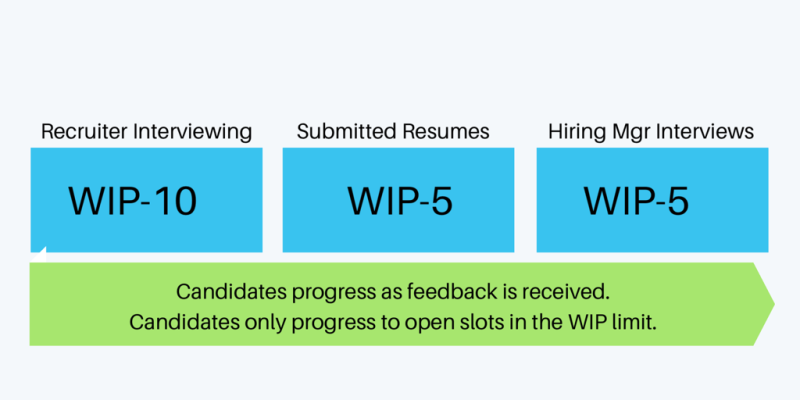
Every recruiting process, no matter how complicated your org chart makes it look, comes down to three lanes where candidates actually wait. Getting this right is what makes limits enforceable, because you cannot cap a stage you have not defined.
- Recruiter screening and interviewing. Candidates the recruiter has engaged and is actively assessing.
- Hiring manager submissions. Candidates sent to the manager for review, sitting in that manager's queue awaiting a yes or no.
- Hiring manager interviewing. Candidates actively scheduled with or being interviewed by the hiring team.
The critical shift is that candidates get pulled into the next lane when a slot opens. A slot opens when a candidate advances or gets disqualified. Under the traditional model, recruiters push candidates forward continuously and the downstream stages absorb whatever arrives. That is how you end up running the chocolate factory instead of the clean shop you want. Every disqualification becomes an asset under a pull system, because it frees capacity for a stronger candidate to move.
The behavior change lands hardest on hiring managers, and the objection is always some version of fear of missing out on the other good candidate still out there. I have watched that fear cost more hires than any limit ever did. The perfect candidate frequently had already been identified and interviewed, then took another offer while the manager held out for someone hypothetically better. Limits kill that pattern by forcing a decision on the people already in the room.
What WIP Limits Should You Set for Each Stage?
Set your limits by testing, then hold them. Here is the sequence we ran, along with the numbers we landed on.
- Test one team-wide limit before you customize. We debated hard over whether high-volume recruiters needed different limits from those working mid-level and executive roles. We tested it. Variance between the two was minimal, and one shared limit across the team was dramatically easier to monitor. Start uniform.
- Cap the hiring manager submission stage at five. We opened at ten and it broke immediately. Managers either complained we were sending too many candidates or complained they had no time to review them, and a third group slid into analysis paralysis. Five is where the stage started moving.
- Cap hiring manager interviewing at five as well. We reasoned that if five submissions overwhelmed a manager, more than five active interviews would be worse. That held up.
- Instrument the queue so you see the block within 48 hours. The whole point of a limit is that a full stage becomes a visible alarm. When a manager stops giving feedback, the submission lane fills, and you know within two days rather than two weeks. Then you go make one phone call.
- Say the tradeoff out loud to your hiring managers. Tell them plainly what they get in exchange for the cap: fewer candidates at a time, faster decisions, and a materially better chance of closing the finalist they actually want. Managers accept limits when they understand the limit is protecting their hire.
Expect discomfort in the first two sprints. Everyone on my team fought the limits initially, myself included. This was the single hardest piece of the methodology to install, and it produced more measurable improvement than anything else we did.
What This Means for You as a Leader
Recruiting teams get judged on speed while being managed on volume, and those two things pull in opposite directions. The teams that break out of it stop asking their recruiters to hold more and start capping what any stage is allowed to hold. Almost a year into running limits, our team used them for two things: tracking candidates, and knowing precisely where to focus that day.
The reason limits work is boring and structural. A full stage is information. It tells you where the process stopped, who owns the block, and what conversation you owe someone before lunch. Without limits, that same block hides inside a general feeling that recruiting is busy and slow.
For the full framework, including how limits interact with sprint planning and retrospectives, search the Sprint Recruiting category on the blog.
FAQ
What are WIP limits in recruiting?
WIP limits in recruiting are explicit caps on how many candidates can occupy a single stage of your hiring process at one time. When a stage hits its cap, no new candidate enters until one advances or gets disqualified.
How do WIP limits speed up hiring if they slow down intake?
Little's Law explains it: cycle time equals work in progress divided by throughput, so reducing what is in flight reduces how long each item takes (Kanban University). Less waiting and less task switching means candidates move through faster at the same level of effort.
What is a good WIP limit for hiring manager reviews?
We landed on five candidates per manager, per requisition. Ten produced complaints and analysis paralysis. Five kept managers engaged and decisions moving, though you should test your own number over two or three sprints.
Should high-volume recruiters have different WIP limits?
We tested separate limits for high-volume versus mid-level and executive recruiting and found very little variance between them. A single team-wide limit was easier to monitor and worked just as well.
Why do hiring managers resist WIP limits?
Almost always because of fear that a better candidate is still out there undiscovered. In practice, that fear costs more hires than the limit ever does, since strong finalists accept other offers while managers wait for a hypothetical upgrade.
What is the difference between pushing and pulling candidates?
Pushing means moving candidates forward whenever they are ready, regardless of downstream capacity. Pulling means the next stage draws a candidate in only when a slot opens, which keeps queues short and makes bottlenecks immediately visible.